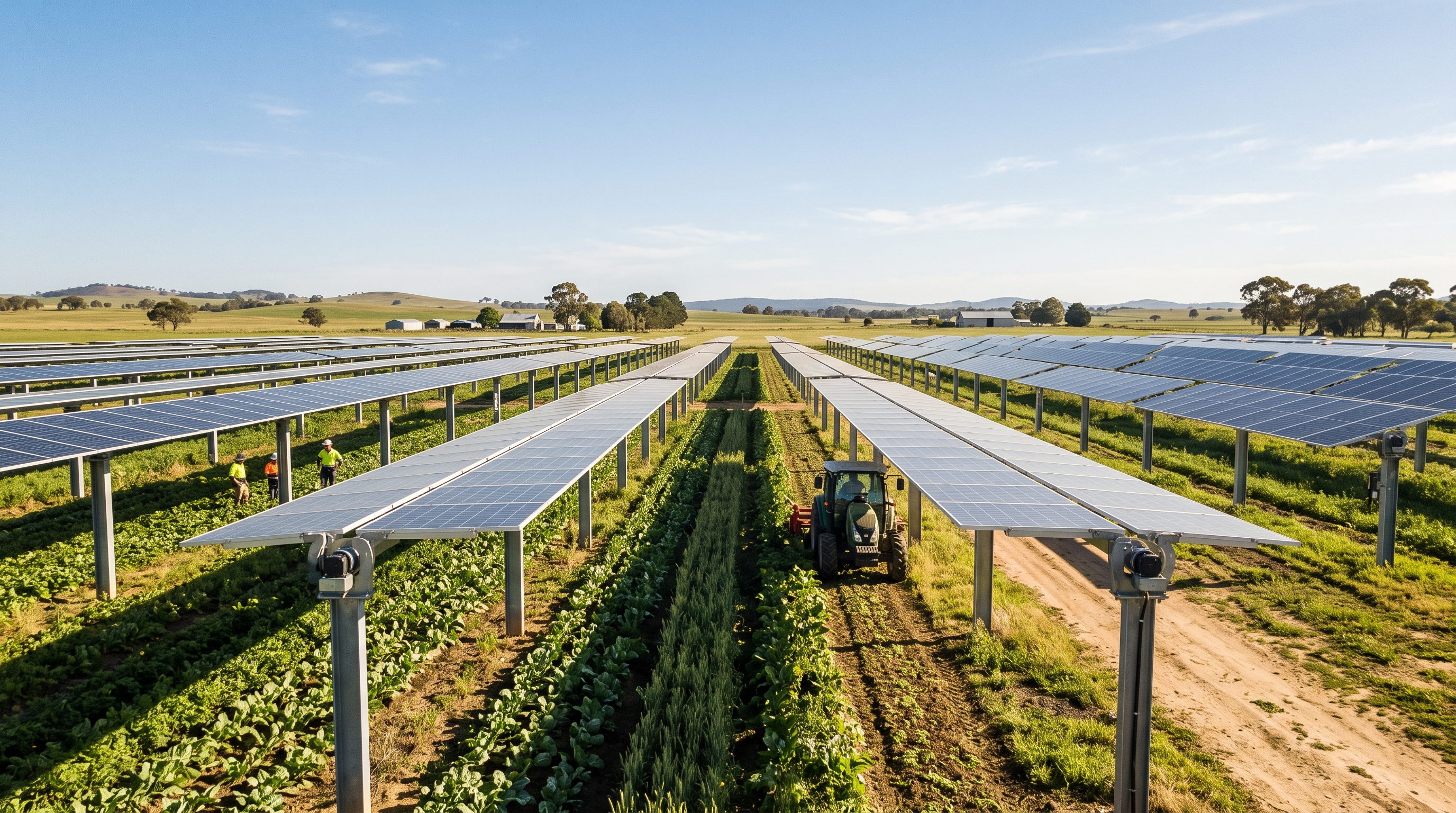
Copernica Partners opens direct investments in battery storage and solar PV projects in Germany to private investors: real energy assets with ongoing power revenues.
A six-figure real asset from €10,000 to €20,000 of equity.
You build a six-figure asset and typically put up €10,000 to €20,000 of your own funds. The rest is covered by a bank loan, for which the bank assesses your creditworthiness, and by the state-backed tax effects from the investment deduction, special depreciation and declining-balance depreciation.
2
Predictable income across decades.
Electricity revenues run for 15 to 30 years and deliver a profile much like property: a hard asset with ongoing income. Only without tenants, with professional operation, and with a far stronger depreciation lever for your liquidity.
3
An above-average pure project return.
8 to 12 % a year, after all costs and before tax, calculated on the investment volume and without any tax lever. A buy-to-let property sits at 2 to 4 %, a broad equity market at 6 to 8 % over the long run. With us the tax lever comes on top rather than being what makes the case work in the first place.
01Why invest in energy now
Investing in the energy transition: now, not in 10 years.
Electrification and the coal phase-out are driving electricity demand; solar increasingly covers it, and storage shifts it into the hours when it is needed most.
The legally anchored build-out of renewables, tax incentives and rising energy demand all pull in the same direction.
By investing in the energy infrastructure of tomorrow you benefit from long-term trends and tend to achieve more attractive returns than with real estate.
Direct investments in projects usually reserved for institutional investors.
Copernica Partners is a broker and long-term partner for direct investments in solar PV and battery storage, not an asset manager pooling capital into funds. The four points below show what that means in practice.
Access
Off-market projects
Vetted solar and storage projects from our network, rarely accessible to private investors.
A pipeline of carefully vetted solar and storage projects from our network of leading European project developers, the kind private investors can rarely access in this market.
Real asset
Direct ownership
No fund wrapper, no capital pool. You become the direct owner of real German energy infrastructure.
No fund wrapper, no capital pool. You become the direct owner of real German energy infrastructure.
Substance
Verified substance, honest numbers
Independent yield assessments, fair prices and a secured tax concept, disclosed before signing.
Independent yield assessments, fair purchase prices, high-quality components and a thoroughly secured tax concept, fully disclosed before signing.
Support
Support across the entire term
Project selection, support through closing and regular reporting over the project's lifetime.
Project selection, support with financing and closing, plus regular reporting and long-term support throughout the project's lifetime.
“The energy transition is one of the greatest economic opportunities of our time. Yet attractive investments were long reserved for institutional investors. We founded Copernica to open exactly that access to private investors, so they can take part in it as future owners of the energy transition.”
Leon Heinrich
Co-Founder · Copernica Partners
04Tax benefits
Three government incentives.
We select projects so they stand as attractive investments in their own right; the three tax levers (IAB, Sonder-AfA and declining-balance depreciation) additionally ease the entry. The calculator runs them with your numbers.
Your inputs
Illustrative only
Assessment
€
Taxable income p.a.
€
Acquisition cost of the asset
§7g EStG tax levers
LeverDepr. · EffectDeductionTax effect
IAB (50 %)Pre-deduction up to 3 yrs before purchase€150,000€63,793€63,793
Sonder-AfA (40 %)40 % on the post-IAB AfA basis€60,000€26,959€26,959
Declining-balance AfA (15 % of residual value)Year 1, for solar€22,500€10,110€10,110
Your marginal tax rate
incl. solidarity surcharge
44.3 %
Total tax effect
IAB (yr 0) + AfA (yr 1), simplified
€100,862
(33.6 % of investment)
Effective equity outlay
How much additional equity is needed?
Bank financing and the tax refund in the year of acquisition cover most of it; you contribute the rest as equity. The loan is subject to the bank's assessment of your creditworthiness.
Total investment
€300,000
Debt€210,000
Bank financing70 %
IAB tax refund€63,793
§7g (1) EStG, year 021.3 %
Additional equity€26,207
beyond tax refund8.7 %
70 %
60 %Typical for secured renewable assets: 65–75 %80 %
Additional equity
beyond the tax refund
€26,207
(8.7 % of investment)
Important note. This example calculation is for illustration only and is neither tax nor investment advice. Actual amounts depend on project data, the chosen AfA method (straight-line or declining-balance), financing structure and your individual tax situation, and must be confirmed with a tax advisor. Direct investments are entrepreneurial holdings; the return potential comes with a corresponding risk of loss.
05How it works
We discuss your situation and your investment goals. Free and non-binding.
01
Initial conversation
We understand your situation, your investment volume and your objectives, in 30 minutes, free of charge and without obligation.
We present curated projects with all documentation: site, technology, permits, revenue model, financing, sensitivities, scenarios. We explain every position in detail until every question is answered.
r
03
Tax structuring
Together with your tax advisor or our partner firms, we structure the IAB (§7g (1)) and further tax benefits for you on request, and support you with the financing.
l
04
Long-term support
We remain your point of contact across the entire holding period and beyond: ongoing electricity revenues, regular reporting, technical and tax service. Your capital works without stress for you.
r
06Who we are
Trust is the most important asset class.
Leon Heinrich
Managing Director & Co-Founder
Responsible for project sourcing, structuring and due diligence. Highly analytical, he draws on academic and hands-on experience in data science and operations to dive deep into the numbers and evaluate every project rigorously, so only the strongest make it into the portfolio and we can present you with a carefully vetted risk-reward profile.
Jakob Hubert
Managing Director & Co-Founder
Responsible for investor relationships across the entire project lifetime: from the initial conversation through the purchase and beyond. A trained economist with experience advising companies in the energy and renewables sector, focusing on project development, financing and portfolio strategy. Your dedicated point of contact for everything around your investment.
Ready to learn more?
Learn how, by investing in energy infrastructure, you become an owner of the energy transition and can benefit from long-term returns.
What level of income makes a direct investment worthwhile?
The structure becomes worthwhile from an annual taxable income of roughly €120,000 to €150,000, at which level you are reliably in the top tax bracket of 42 % (around 44 % including the solidarity surcharge), so the IAB and Sonder-AfA can fully unfold their effect. The equity actually required is significantly lower than the nominal investment volume: a substantial part is carried by the early tax refunds from the IAB. Typical project investments start at around €100,000 in volume.
How does this compare to a tax-advantaged real-estate investment?
Real estate has long been the default tax shelter for German private investors. But the math has shifted. Denkmal-AfA and Sonder-AfA on Neubau are volume-capped and supply-constrained, residential yields in attractive locations have compressed below 3 %, and the operating burden (tenancy law, maintenance, regulatory exposure) keeps growing. A PV or BESS direct investment delivers a comparable real-asset profile with materially stronger tax levers in the early years (IAB plus Sonder-AfA together reach around 70 % of the investment amount in deductions) alongside a clearly bounded technical risk profile and revenues tied to a structurally growing market (Energiewende, electrification of mobility and heat). Most of our clients arrive having already built a real-estate position and view Copernica as the natural next allocation.
How does the Investitionsabzugsbetrag (IAB) under §7g EStG work?
You can deduct up to 50 % of the planned investment amount from taxable profits in the three years before purchase. In the year of acquisition, Sonder-AfA (§7g (5) EStG, up to 40 % cumulative over 5 years) and straight-line or declining-balance AfA (§7 (1) or (2) EStG) are added on top.
What returns are realistic?
Returns depend on project site, revenue model, financing structure and your individual tax situation. In every initial conversation we walk through the sensitivity calculation for the specific project across three scenarios (best / mid / worst). Because these are entrepreneurial investments, we do not make return promises.
How does the investment protect against inflation?
Three structural levers. First, you own a real asset, the physical PV or storage installation, whose replacement cost rises with inflation. Second, revenue is tied to electricity prices: PPAs are typically index-linked, and the merchant portion participates directly in market price movements. Third, project debt is usually fixed-rate over 10–20 years, so inflation erodes the real debt burden while revenues adjust upward. The combination has historically made energy infrastructure one of the more reliable inflation hedges among real-asset classes.
Does Copernica only accompany me up to signing?
No. And that is a key difference. We remain your point of contact across the entire holding period and beyond. This includes regular reporting, account management, technical and tax service. The goal is for your capital to work, without stress for you.
What's the difference between Copernica and a classic fund?
You participate directly in the real asset, not in a fund wrapper. That means: no fund management layers between you and the asset, full tax levers as an entrepreneurial investor, and immediate impact of project performance on your position.
What real-world impact does my investment have?
Every project we broker comes with a measurable impact profile: annual MWh produced or stored, tons of CO₂ avoided versus the German grid mix, and the household equivalent the asset powers or stabilizes. A mid-sized rooftop PV project of around €500,000 typically avoids 150–200 t CO₂ per year over a 20-year lifetime, roughly 3,500 tons cumulative, the lifetime emissions of dozens of households. You receive this data in your regular reporting alongside the financial figures, so the impact is auditable, not aspirational.
What does working with Copernica Partners cost?
The initial conversation is free of charge. For the brokerage we charge a commission on the purchase price; for ongoing support of your investment we charge a service and asset-management fee. All terms are disclosed transparently before signing.
What risks exist?
Direct investments are entrepreneurial holdings; as with any return-oriented investment, the opportunities come with a corresponding risk of loss. The relevant risks are in particular: power-price and market risk, technical risk (availability), financing risk and regulatory risk. We address these structurally (through co-located structures, established direct marketers, insurance and standard contracts) but we cannot eliminate them.
How quickly can I invest?
From the first conversation to signing typically takes 4–6 weeks. To make use of the IAB in the current tax year, we work to a compressed timeline on request.
Beyond the depreciation effects, are there further ways to optimise tax?
Yes. The IAB and Sonder-AfA are the immediate lever, but not the only one. Depending on your personal situation, further structuring can be examined: for example bundling several investments, contributing them into a corporation or holding structure at a later point, or shaping the ongoing taxation across multiple years. Which options make sense depends heavily on the individual case; a one-size-fits-all answer is not possible here. On request we walk through this together with the tax advisers we work with (this conversation does not replace tax advice; the concrete structuring remains the responsibility of your tax adviser). What is clear: beyond pure depreciation, there are usually several points of leverage.
How significant is the regulatory risk, and how do you handle it?
The regulatory risk is real and is one of the relevant risks of an investment. The energy market is highly dynamic politically: support regimes, grid fees, market design and the tax framework keep evolving. This risk cannot be eliminated. We do, however, aim to stay continuously up to date and work with law firms specialised in energy law to do so. That lets us position and accompany our investors as accurately as possible on every investment.
What does the debate about skimming electricity-price peaks mean for my revenues?
The debate concerns skimming revenue peaks, that is, returns above a secured level. For EEG-funded photovoltaic projects, the market premium (Marktprämie) forms a floor over 20 years and thus a stability anchor. Battery storage, by contrast, earns pure merchant revenue from arbitrage and balancing services, without an EEG floor. As things currently stand, interventions target windfall profits in extreme phases, not this floor.
Can I invest in a solar park or battery storage as a private individual?
Yes. You acquire the plant directly and hold it in a business of your own, typically a sole proprietorship (Einzelunternehmen), or a GbR for a co-investment. This route is open to employees as well; an existing business is not a requirement. Which structure fits your situation is something we clarify in the initial conversation together with your tax adviser (the conversation does not replace tax advice).
How does investing in a solar park differ from investing in battery storage?
A solar park generates electricity and sells it via the EEG market premium or long-term offtake agreements (PPAs); the market premium forms a floor over 20 years and makes revenues well plannable. A battery storage system does not generate electricity but shifts it: it buys in low-price hours, sells in expensive hours (arbitrage) and additionally provides balancing services for grid stability. Its revenues are market-driven and therefore more volatile; in return, storage participates more strongly in growing price volatility. Many projects combine both as a co-located asset.
How can I save taxes with renewable energy?
The central lever is the combination of the Investitionsabzugsbetrag (§7g (1) EStG) and the Sonder-AfA (§7g (5) EStG): together they allow cumulative depreciation of around 70 % of the investment volume to be pulled into the early years, which significantly reduces the tax burden at the top tax rate. The prerequisite is an entrepreneurial stake in the asset, for example in a battery storage or photovoltaic project. Whether and to what extent the effects apply to you depends on your individual situation and belongs in the discussion with your tax adviser; our example calculations do not replace tax advice.
Want to dig deeper? Find all the background on taxes, markets and direct investments in our Insights section.
Direct investment in solar PV and battery storage
An investment in renewable energy is an entrepreneurial stake in real energy infrastructure: a solar park, a rooftop or ground-mounted photovoltaic system, or a battery storage system (BESS). Unlike a fund share, a direct investment means you acquire the asset itself; our article Direct investment or closed-end fund explains the structural comparison. As a real asset with ongoing power revenues, energy assets are also considered a solid building block for inflation protection in a portfolio; the overview Investing in battery storage: the options at a glance shows the routes into a battery storage investment.
Saving tax with the Investitionsabzugsbetrag under §7g EStG
Let's discuss how you invest in real energy assets.
In a non-binding initial call we analyse your situation and investment goals and work out together which projects, markets and investment strategies fit you.